


Meerkats: Survival Takes a Group
A small sentinel. A bigger story.
A meerkat stands above the scrub, head turning towards the sky. Nearby, others dig with their noses close to the soil. Between them, quiet calls carry across the feeding ground.
It is a familiar scene with a practical challenge beneath it: how do you find enough food, when looking down makes it harder to spot danger above?
For the meerkat, survival involves constant adjustments between hunger, vigilance and life with others.
Shop the story
Wildlife-inspired gear from Africa Wild Child
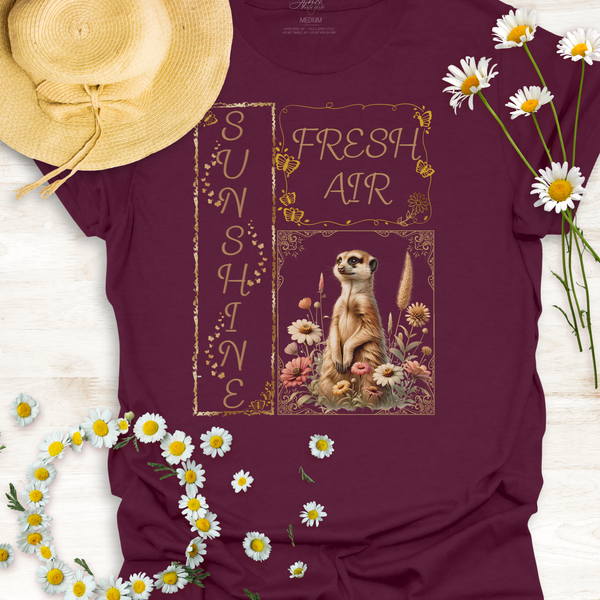


A Life Above and Below Ground
The meerkat, Suricata suricatta, belongs to the mongoose family. It inhabits dry, open country across parts of South Africa, Namibia, Botswana and southwestern Angola. SANBI’s species profile describes its southern African range.
Daylight brings the search for food. Insects and their larvae dominate the diet, supplemented by other small prey. Strong foreclaws help uncover meals hidden beneath the surface. Field research on meerkat foraging shows how feeding changes with seasonal conditions.
Burrows provide refuge from predators and temperature extremes. Meerkats dig and modify underground shelters, sometimes sharing systems with ground squirrels or yellow mongooses. The ground beneath a sighting can hold a network of connections of its own. Scientific species account.
 Alert Meerkat Emerging from Burrow ~ Photo by Andreas Berget from Pexels
The Work of Living Together
Meerkat groups usually contain a dominant breeding pair and helpers that assist with raising young. Babysitting and feeding pups spread the demands of care beyond their parents. Regional conservation assessment.
Keeping watch helps others feed. Experiments found that short sentinel calls encouraged foraging and reduced vigilance, while longer calls prompted listeners to become more watchful. The calls convey changes in perceived danger before an immediate escape is necessarily required. Rauber and Manser, 2017.
Watching also benefits the lookout. Research found that well-fed animals were more likely to guard, often from relatively safe positions. There is no fixed duty roster. Clutton-Brock and colleagues, 1999.
Cooperation has a harder edge too. Dominant females can evict reproductive rivals and kill their pups. Group life brings protection and assistance alongside competition over breeding. Research on reproductive suppression.
 Two meerkat guarding outside the burrow. One foraging and the other on look-out. ~ Photo by Yassine Chaachoua from Getty Images
A Small Predator in a Larger Food Web
A meerkat’s place in the landscape extends beyond its group. It consumes smaller animals and can itself become prey for raptors and terrestrial carnivores.
Those feeding relationships connect it to the wider community. Its value does not depend on proving that it controls pests or transforms an entire ecosystem. Understanding what it eats, what hunts it and where it shelters already reveals why its surroundings matter. Research on predation and mortality.
 Closeup of a Meerkat eating a grasshopper ~ Photo by Toos from Getty Images Signature
When the Rain Fails
Meerkats are classified as Least Concern, but broad distribution does not protect every group from difficult years. Conservation assessment.
A 2025 study of a southern Kalahari population linked the exceptionally dry 2012–2013 breeding season with declines exceeding 50% in average group size and population density. Across the study period, low rainfall had greater demographic consequences than unusually hot years. Thorley and colleagues, Oikos.
Companion research linked rainfall and vegetation productivity with feeding success, body condition, breeding and survival. High summer temperatures were associated with reduced foraging performance, with particularly difficult conditions when heat coincided with low productivity. These findings concern the studied population, rather than every meerkat across southern Africa. Thorley and colleagues, Ecological Monographs.
Even an accomplished survivor depends on conditions that cooperation cannot fully overcome.
 Meerkat - Front view, close up ~ Photo by 3D_generator from Getty Images
How You Can Help
Choose guides who respect natural behavior. Observe quietly, leave burrow entrances clear, and never feed, handle or lure wild meerkats for photographs. SANParks guidance prohibits feeding and intentional disturbance of wildlife in its parks.
Support credible habitat conservation and long-term field research. Ask how a wildlife experience benefits the animals, the landscape and local people.
Stay Long Enough to Understand
The sentinel drops to all fours and returns to the feeding ground. Another meerkat pauses to scan.
Knowing more changes the encounter. You begin to see the work behind the familiar pose, the competing demands within the group, and the importance of rain far beyond the moment it falls.
Give that life space to continue.
Protect Africa’s Wildlife Today
Sources
-
Rauber and Manser (2017): Sentinel calls and perceived predation risk.
-
Clutton-Brock et al. (1999): Selfish sentinels in cooperative mammals.
-
Clutton-Brock et al. (1999): Predation, group size and mortality.
-
Thorley et al. (2025): Temperature, rainfall and population dynamics, Oikos.
-
Thorley et al. (2025): Climate variability and demography, Ecological Monographs.
-
SANBI and Endangered Wildlife Trust: Regional conservation assessment.
All images are the property of the copyright holders. Attribution provided alongside each image.


